FAQ

Are quartz watches accurate?

Yes, quartz watches are known for "high accuracy." Because the quartz crystal vibrates at such a stable and high frequency, they are typically much more accurate than mechanical watches, often varying by only a few seconds per month.

How does a quartz watch work?

It works through a circuit: a battery sends electricity to a quartz crystal, causing it to oscillate (vibrate) 32,768 times per second. A microchip detects these vibrations and converts them into regular electric pulses (one per second). These pulses drive a stepping motor, which turns the gears and moves the watch hands.

What is a quartz watch and what does "quartz movement" mean?

A quartz watch is a timepiece powered by a battery rather than a wound spring. The "quartz movement" refers to the internal engine of the watch, which uses a tiny crystal of quartz mineral to regulate time. This crystal vibrates at a very precise frequency when electricity is passed through it, ensuring high accuracy.

Is a Chronograph different from a Chronometer?

Yes, these terms are often confused but mean different things. A Chronograph is a watch with a built-in stopwatch function (buttons to start, stop, and reset). A Chronometer is a specific certification given to a high-precision watch movement (usually mechanical) that has passed rigorous accuracy tests by COSC (Official Swiss Chronometer Testing Institute). A watch can be both, but "Chronograph" refers to the function, while "Chronometer" refers to the accuracy rating.

Can I leave my chronograph running all the time?

While possible, it is generally not recommended for battery-powered quartz watches. Leaving the chronograph function running continuously drains the battery significantly faster than standard timekeeping. To preserve battery life, we suggest stopping and resetting the chronograph hands to zero when you are not actively timing an event.

How do I choose the right watch size for my wrist?

The ideal watch size depends on your wrist circumference and personal style. As a general rule, for wrists under 15cm, case diameters between 20mm and 30mm look most balanced. For wrists between 15cm and 17cm, sizes from 30mm to 35mm are ideal. For larger wrists, cases 35mm and above provide a bold look. Jowissa offers a variety of sizes, ranging from our petite 20mm mini models to our larger 45mm options for men.

Why should I not change the date between 9 PM and 3 AM?

This rule applies to both quartz and automatic watches. You should avoid manually changing the date during these hours (the "danger zone") because the watch's internal gears are already engaging to advance the date automatically. Forcing a manual change while these gears are locked can break the delicate teeth of the movement. Pro tip: To be safe, always pull the crown out and move the hands to 6:30 before setting the date, then reset the time to the correct hour.

What does "Swiss Made" actually mean?

A watch can only be labeled "Swiss Made" if it meets strict legal standards set by the Swiss government. It requires that the movement is Swiss, the movement is cased up in Switzerland, and at least 60% of the production costs of a watch taken as a whole must from Switzerland. At Jowissa, we proudly assemble our watches by hand in Bettlach, Switzerland, ensuring every timepiece meets these high standards of quality and precision.

On what wrist does a man wear a watch?

Traditionally, a man wears his watch on the left wrist. This custom originated because the majority of people are right-handed, and wearing a watch on the non-dominant hand protects the timepiece from damage and keeps the dominant hand free for writing or working. However, the modern rule is practical: wear your watch on the wrist opposite your dominant hand. Therefore, if you are left-handed, it is perfectly acceptable to wear your watch on the right wrist.

What are luminous hands?

Luminous hands on a watch refer to the hands (hour and minute, and sometimes the second hand) that have been treated with a phosphorescent material. This material absorbs light from various sources, such as sunlight or artificial light, and then emits that light over a period of time, allowing the wearer to read the time in low-light or dark conditions.

At Jowissa, we incorporate luminous hands into select models to enhance their practicality and legibility. This feature ensures that the time can be easily discerned, even when visibility is limited. The application of luminous material is carefully considered in our designs to complement the overall aesthetic of each timepiece while providing functional benefit to the wearer.

Is my watch water resistant?

A Jowissa watch is tested for 3 to 20 ATM water resistance depending on the collection.
3 ATM: Watches tested for 3 ATM should not be worn when bathing or showering. They are build to withstand light rain, sweat and brief water contact.
5 ATM: Watches tested for 5 ATM are made to withstand rain, sweat and short swims.
10 ATM: Short dives, swim and other water sports are ok
20 ATM: Deep Dives, swims and other water sports are ok.

What is the meaning of the brand name JOWISSA?

The name Jowissa is a combination of the surname and lastname of the company founder Josef Wyss. He founded Jowissa in the village of Bettlach, Switzerland in 1951. Jowissa has been active and in business without interruption since then.

Can I swim with my watch that is tested for 5 ATM?

A watch with a water resistance rating of 5 ATM (atmospheres) is suitable for everyday use and can withstand splashes, rain, and showering. According to ISO standard 22810, this level of water resistance signifies that the watch can withstand static pressure equivalent to submersion at a depth of 50 meters.

While a 5 ATM rating offers more protection than a 3 ATM rating, it is important to understand the limitations for swimming. The dynamic forces exerted during swimming, such as the movement of your arms through the water and the impact of diving, can create pressure that exceeds the static test conditions.

Therefore, while your Jowissa watch with a 5 ATM rating can tolerate brief immersion and splashes, we generally advise against wearing it for prolonged swimming or diving activities. Consistent exposure to these conditions may compromise the water-resistant seals and potentially lead to water damage which would not be covered under the warranty.

For regular swimming or more intensive water activities, we recommend considering Jowissa models with a higher water resistance rating, typically 10 ATM or more. These models are specifically designed and tested to withstand greater water pressure and are more suitable for such use. Please refer to the technical specifications of each Jowissa watch on our website for detailed information on their water resistance level.

What is a Tachymeter for and how to use it?

A tachymeter is a scale inscribed around the bezel of an analog watch, or sometimes printed on the dial, used to compute speed based on travel time or measure distance based on speed. It is particularly useful for measuring the speed of a moving object over a known distance or the distance covered at a constant speed.

How to Use a Tachymeter to Measure Speed:
1. Know the Distance: First, you need to know a fixed distance, typically one kilometer or one mile.
2. Start the Chronograph: As the moving object (e.g., a car) passes the starting point of your measured distance, start the chronograph function of your Jowissa watch. This is usually done by pressing the top pusher next to the crown.
3. Stop the Chronograph: Once the moving object reaches the end of the measured distance, stop the chronograph by pressing the same top pusher.
4. Read the Speed: Observe the position of the chronograph's central seconds hand on the tachymeter scale. The number on the tachymeter scale corresponding to the seconds hand's position indicates the speed in units per hour (kilometers per hour or miles per hour), based on the one-unit distance you measured.
- For example, if it took 30 seconds to travel one kilometer, the seconds hand would point to "120" on the tachymeter scale, indicating a speed of 120 kilometres per hour.

How to Use a Tachymeter to Measure Distance:
1. Know the Speed: You need to be traveling at a constant speed.
2. Start the Chronograph: As you begin timing, start the chronograph function of your Jowissa watch.
3. Time a Duration: Let the chronograph run for a specific amount of time, for example, 60 seconds.
4. Read the Distance: Note the number on the tachymeter scale corresponding to the position of the chronograph's central seconds hand. This number represents the distance traveled in the unit of speed you are using (kilometers or miles) during that specific time interval (e.g., per minute if you timed for 60 seconds).
- For example, if you are traveling at a constant speed and after 60 seconds the seconds hand points to "80" on the tachymeter scale, you have traveled 0.8 units of distance (kilometers or miles) in that minute.

The tachymeter function on your Jowissa chronograph is a testament to the precision and functionality inherent in our timepieces, blending traditional horological features with practical applications for everyday life.

Sporty Precision: The 42mm Watch

The 42mm watch is the preferred size for functionality and sportiness. Perfectly suited for chronograph dials with multiple sub-dials, this size offers optimal readability. Our LeWy collection utilizes the 42mm case to showcase detailed Swiss design and robust aesthetics. It is substantial enough to feel masculine and sporty, yet refined enough for everyday wear.

Why shop Jowissa
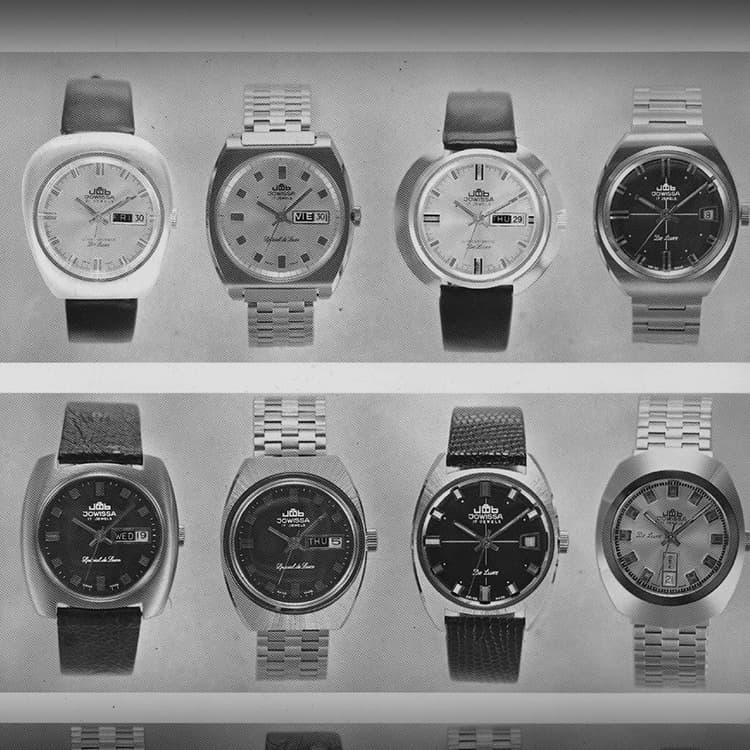
Jowissa's enduring legacy in men's watchmaking since 1951, all Swiss Made

Enduring Legacy since 1951

Jowissa's enduring legacy in men's watchmaking is evident in every piece, showcasing a commitment to Swiss precision and a unique design philosophy honed since 1951.

Swiss Made - Manufactured in Switzerland by Jowissa - Assembled by hand - Automatic watches and quartz watches.

(Hand) Made In Switzerland

Each Jowissa watch is assembled by hand in Switzerland. We strive for excellence in production and quality control since 1951. Choosing to shop with Jowissa provides you with the distinct advantage of owning a meticulously crafted timepiece that carries the legacy of Swiss craftsmanship, ensuring exceptional quality and attention to detail.